Not every outdoor space can accommodate monolithic lounge sets or heavy cast-iron dining arrays. For urban balconies, narrow terraces, or gardens requiring flexible entertaining layouts, seating must be transient. This necessitates chairs engineered specifically for spatial efficiency: the folding and the stackable.
The architectural challenge of a folding chair is immense. A fixed chair relies on triangulated rigid joints to distribute weight evenly down to the floor. A folding chair, by definition, breaks these rigid joints, introducing pivot points and moving parts. Every hinge is a potential point of failure. Consequently, the quality of a folding chair is entirely reliant on the engineering of its articulation.
In wooden folding chairs, the laths (the individual slats forming the seat and back) must be robust enough to support body weight while remaining thin enough to close tightly. Brass or marine-grade stainless steel rivets are non-negotiable here. Inferior galvanized steel rivets will rust, swell, and eventually snap, rendering the chair useless. The classic 'bistro' chair—often utilizing a powder-coated steel frame with curved wooden slats—represents a historically proven geometry that balances comfort with a highly compact folded footprint.
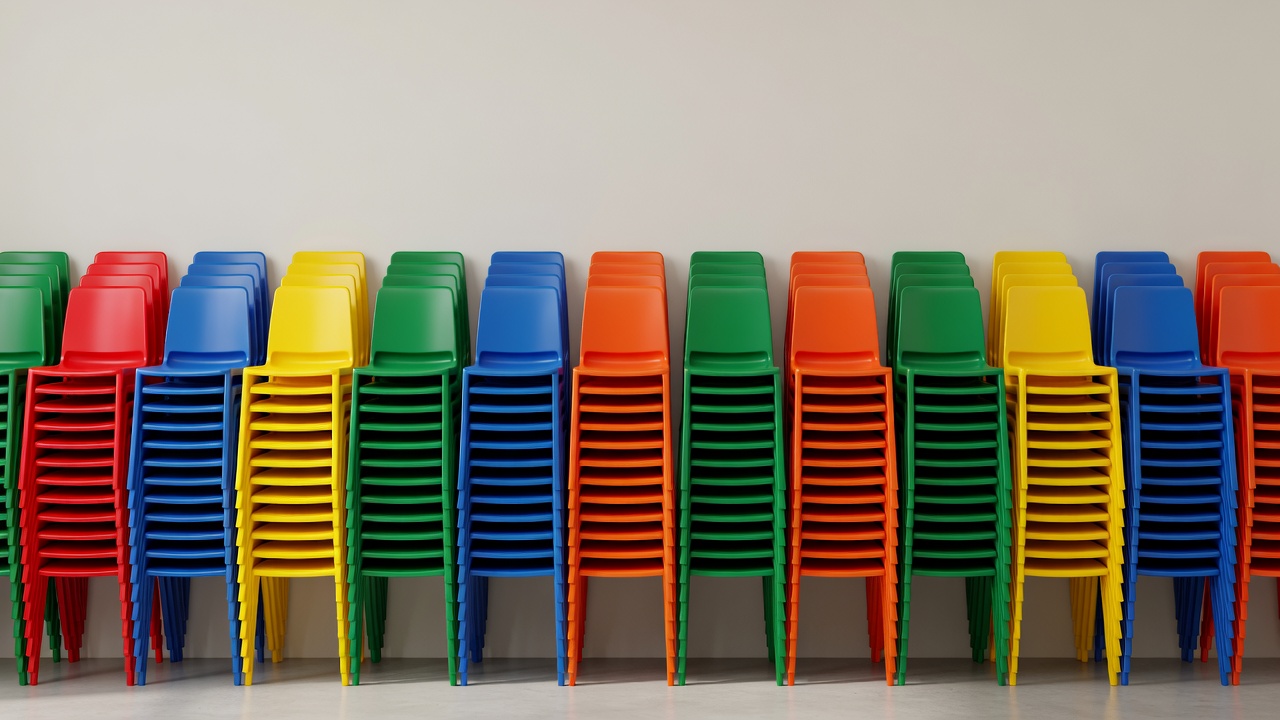
Stackable chairs solve the spatial problem vertically rather than horizontally. Instead of articulating, the chair's fixed geometry is designed so that the legs of one chair slot precisely outside the frame of another. This allows multiple chairs to be nested into a single column. Stackable designs are exceptionally common in injection-molded plastics and lightweight aluminium tubing.
When evaluating stackable chairs, the angle of the splay is critical. The legs must taper outward slightly to accommodate the chair above it. However, if this splay is too aggressive, the chair becomes a tripping hazard and requires too much floor space when deployed. Furthermore, the point of contact between stacked chairs must be buffered. High-quality metal stackable chairs feature discrete rubber or nylon bumpers on the underside of the frame. Without these, the paint or powder coating will scratch and degrade every time the chairs are nested or separated.
The Portability Factor
A chair's ability to fold is only half the equation; its weight dictates its true portability. A heavy teak folding chair may save patio space, but lugging a set of four into a winter shed remains a physically demanding task. For ultimate portability, aluminium frames slung with textilene fabric (a woven, PVC-coated polyester) offer the best weight-to-strength ratio.
Textilene requires no additional cushioning, folds virtually flat, and sheds water instantly, making it ideal for variable climates where furniture must be deployed and retracted rapidly based on the weather.
Storage Geometry
Before investing in folding or stackable seating, precise measurements of the intended storage area must be taken. Folding chairs are typically stored horizontally (stacked on their sides) or vertically (leaning). Vertical storage requires a completely flat floor profile when folded; if the chair bows outward when closed, it will not lean stably against a wall.
For stackable columns, vertical clearance is rarely the issue, but stability is. A stack of six plastic monobloc chairs can easily blow over in high winds if left exposed. Storage sheds or designated, sheltered corners are necessary for safe winter nesting.
Ultimately, spatial efficiency should not require a sacrifice in durability. By prioritizing industrial-grade hinges in folding models and protective bumpers in stackable geometries, transient seating can perform just as reliably as permanent architectural fixtures.